Our work on this topic has included two studies (described in greater detail below):
Ethics of Closing Projects 1 (ECP1) (2018-19): In this study we conducted a scoping literature review, interviewed national and international humanitarian workers, and developed a resource to support discussion and reflection about what it means to ‘close well.’ This study included a partnership with Médecins du Monde-Canada.
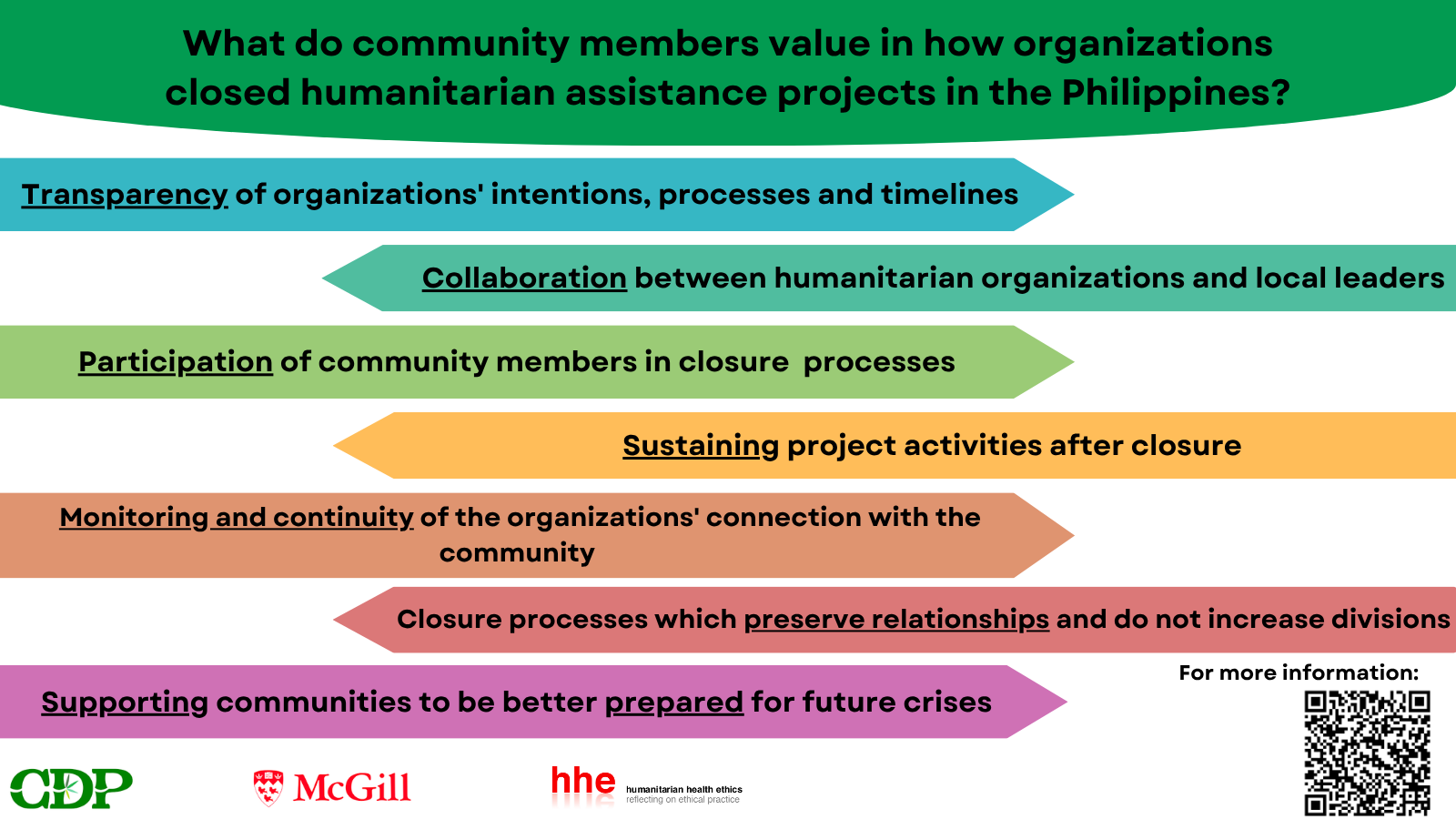
Ethics of Closing Projects 2 (ECP2) (2020-23): Building on our earlier work, we extended our research on project closure to focus on how closures are experienced by communities affected by crises in the Philippines. This study is a collaboration between the Centre for Disaster Preparedness in Manila and the HHE Research Group.
Publications
Pal, N.E., Eckenwiler, L., Hyppolite, SR. et al. Ethical considerations for closing humanitarian projects: a scoping review. Int J Humanitarian Action 4, 17 (2019). https://doi.org/10.1186/s41018-019-0064-9
Hunt, M., Eckenwiler, L., Hyppolite, SR. et al. Closing well: national and international humanitarian workers’ perspectives on the ethics of closing humanitarian health projects. Int J Humanitarian Action 5, 16 (2020). https://doi.org/10.1186/s41018-020-00082
Eckenwiler, L., Hunt, M.R., Crismo, J.J.L.G., Conde, E., Hyppolite, S.-R., Luneta, M., Munoz-Beaulieu, I., Mohammed Saeed, H. and Schwartz, L. (2023), “Viewing humanitarian project closure through the lens of an ethics of the temporary”, Disaster Prevention and Management, Vol. ahead-of-print No. ahead-of-print. https://doi.org/10.1108/DPM-11-2022-0226
Hunt, M., Muñoz Beaulieu, I., & Saeed, H. M. (2023). What Does ‘Closing Well’ Entail for Humanitarian Project Data? Seven Questions as Humanitarian Health Projects Are (Being) Closed or Handed Over. Journal of Humanitarian Affairs, 5(2), 13-23. Retrieved Nov 1, 2025, from https://doi.org/10.7227/JHA.106
Eckenwiler L, Munoz-Beaulieu I, Perez R, Luneta M, Hyppolite SR, Schwartz L, et al. (2025) Thinking through abrupt closure in humanitarian assistance: Key ethical considerations in seemingly impossible conditions. PLOS Glob Public Health 5(6): e0004656. https://doi.org/10.1371/journal.pgph.0004656
Saeed, H. M., Schwartz, L. & Hunt, M. (2022). Ethical Considerations Associated
with Closing a Non-communicable Disease Program in a Humanitarian Setting.
Canadian Journal of Bioethics / Revue canadienne de bioéthique, 5(2), 132–135.
https://doi.org/10.7202/1089793ar
Hunt, M., Muñoz Beaulieu, I., Perez, R., Luneta, M., Ebay, J., Eckenwiler, L., Hyppolite, S., Saeed, H. M., & Schwartz, L. (2025). ‘They Are Still Not Gone Even Though They Are No Longer Here’: What Community Members and Local Stakeholders Valued in How Organisations Closed Humanitarian Assistance Projects in Six Locales in the Philippines. Journal of Humanitarian Affairs, 6(2-3), 28-39. Retrieved Nov 12, 2025, from https://doi.org/10.7227/JHA.128
Beaulieu, I. M., Perez, R., Luneta, M., Eckenwiler, L., Hyppolite, S. R., Saeed, H. M., … & Hunt, M. (2025). What remains after humanitarian organizations leave? An exploration of community perspectives regarding sustainability and humanitarian aid in the Philippines. International Journal of Disaster Risk Reduction, 105921 from https://doi-org.proxy3.library.mcgill.ca/10.1016/j.ijdrr.2025.105921
Muñoz Beaulieu, I., Mohammed Saeed, H., Hunt, M. (2026). Ethical Capacities and Organizational Infrastructure: Navigating Opportunities and Challenges of Artificial Intelligence in Humanitarian Project Closure. In: Koch, B., Winkler, D. (eds) Artificial Intelligence Ethics in Military Medicine and Humanitarian Healthcare. Military and Humanitarian Health Ethics. Springer, Cham from https://doi.org/10.1007/978-3-032-11331-3_13
Guidance notes & resources
| Ethics of Project Closure 1: Ethical and Humanitarian Workers’ Perspectives | Ethics of Project Closure 2: Community Perspectives of What They Value When Projects Close |
| Guidance Note: Ethics and Closing Well | Concept Map: Illustration |
| One Pager: Core Questions to Spark Dialogue | Reading List: Ethics, Temporariness, and Project Closure |
| Full Reference List: Ethics and Project Closure | Guidance Note: What Communities Value in Project Closure |
| Infographic: Summary of Project and Findings | |
| Infographic: Snapshot of Findings |
 HUMANITARIAN HEALTH ETHICS