
“While many project closures unfold smoothly, in other cases they are contested and give rise to ethically challenging situations for humanitarian organizations, their partners, and local communities.”
Non-governmental organizations routinely make and enact decisions to close humanitarian health projects. Doing so is unavoidable, and a necessary component of humanitarian action. However, ethical questions may arise related to why a project is selected to be closed and how closure is implemented. Moreover, these decisions, and the process and impact of closing projects, are likely to be perceived differently from the perspectives of those involved in and affected by them, for example for members of communities where projects are closed, for policy-makers based in organizational offices, or for national and international staff of the organizations.
Different models of closing projects have been utilized, including phasing down (gradually decreasing the project in size, sometimes leaving a small presence in place in case the project needs to be reactivated in the future), phasing over (gradually shifting it to local actors), handing over (transfer of the project to local actors), and ‘cut and run’ (sudden termination of a project). Regardless of the approach taken, ethical considerations are important to consider in planning for and implementing project closure, such as how to do so in ways that treat people with respect, demonstrate accountability, minimize harms, promote lasting benefits, and are equitable.
Our work on this topic has included two studies (described in greater detail below):
Ethics of Closing Projects 1 (ECP1) (2018-19): In this study we conducted a scoping literature review, interviewed national and international humanitarian workers, and developed a resource to support discussion and reflection about what it means to ‘close well.’ This study included a partnership with Médecins du Monde-Canada.
Ethics of Closing Projects 2 (ECP2) (2020-23): Building on our earlier work, we extended our research on project closure to focus on how closures are experienced by communities affected by crises in the Philippines. This study is a collaboration between the Centre for Disaster Preparedness in Manila and the HHE Research Group.
1. Team Members & Partners
ECP1
Research Team: Ryoa Chung, Lisa Eckenwiler, Matthew Hunt, John Pringle, Nicole Pal and Shelley-Rose Hyppolite
Partners: Médecins du Monde-Canada
Funding: RRSPQ Public Health Ethics Axis, 2018-19
ECP2
Research Team: Elyse Rafeala Conde, Jan Jay Louise Crismo, Lisa Eckenwiler, Matthew Hunt, Shelley-Rose Hyppolite, Mayfourth Luneta, Isabel Munoz Beaulieu, Handreen Mohamed Saaed, John Pringle, Lisa Schwartz
Partners: Centre for Disaster Preparedness Foundation, Inc

Funding: Social Sciences and Humanities Research Council
2. Ethics of Closing Projects (ECP2) (2020-23)
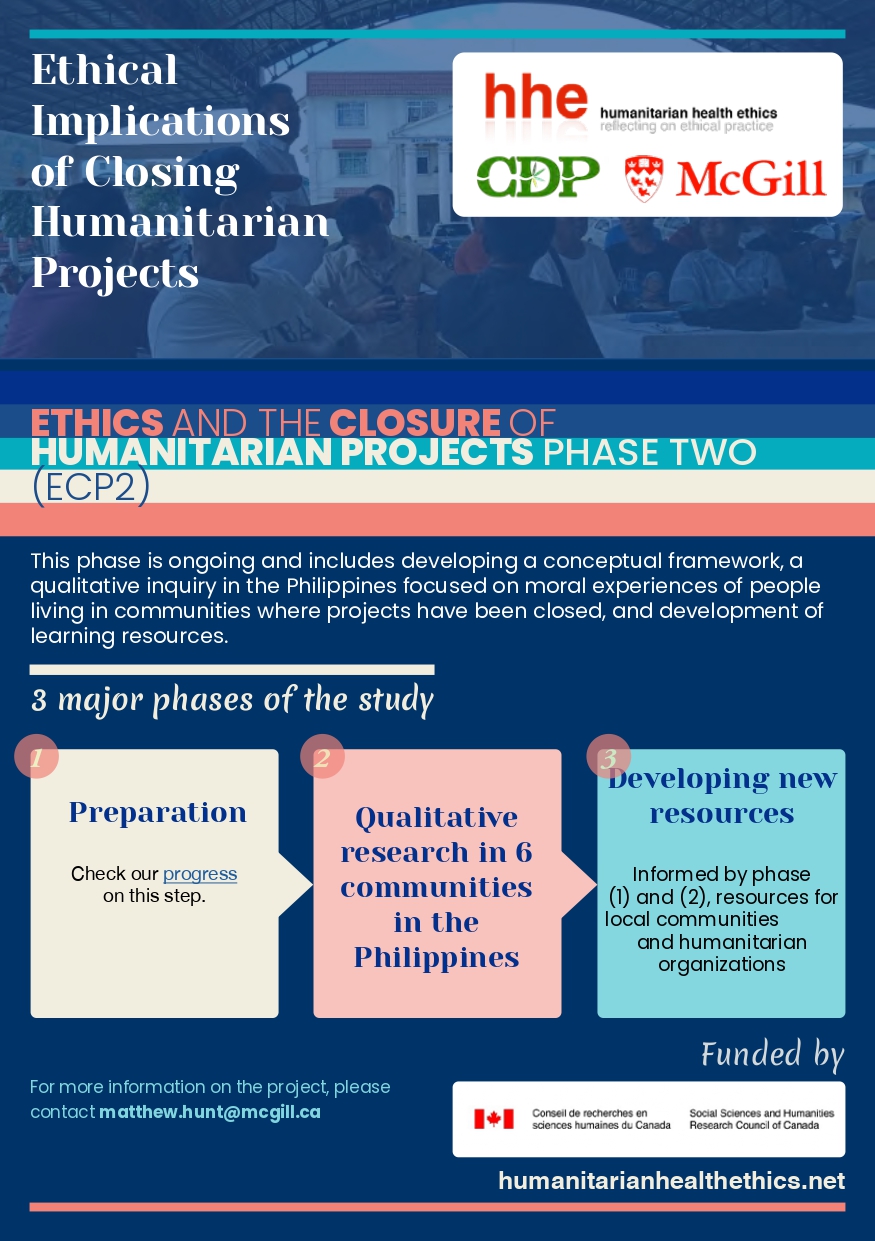
This project involves a collaboration between the Center for Disaster Preparedness (Manila, the Philippines) with researchers at McGill, McMaster, Laval and George Mason Universities. The primary aim of the study is to examine the topic of humanitarian project closure from the perspectives of people living in communities where projects have been closed, as well as perspectives of community leaders and local stakeholders.
This study is entitled “A qualitative inquiry into the ethics of closing humanitarian projects in the Philippines, focusing on moral experiences of community stakeholders”
This project has three interconnected phases
a) Preparation (including partnership activities, articulation of a shared conceptual account, and establishment of a community advisory board)
b) Interviews and focus groups in six communities in the Philippines affected by disaster or conflict and where projects are being or have been closed
c) Co-development of workshops tailored for local communities and humanitarian organizations.

- Preparation Phase:
In the early phase of our project, we focused on building a strong foundation—both conceptually and collaboratively. Regular team meetings helped us refine our approach, and one of our key priorities was forming a Community Advisory Board to guide our work with grounded, community-informed perspectives.
Together, we embarked on a collective reflection to explore ethical dimensions of humanitarian project closure. This process wasn’t just academic—it was relational, reflective, and centered on creating a shared vision. We examined how concepts like justice, solidarity, care, epistemic injustice, and localization intersect with the realities of winding down humanitarian interventions.
To support this work, we co-created a concept map that traces these ideas in relation to what we’ve come to call an “ethics of the temporary.” This framing helps us understand humanitarian action not just as a response to the present, but as a time-bound engagement that is deeply connected to the past and the future. All this, while trying to promote sustainability and greater equity going forward.
If you’re curious to dive deeper:
- 👉 Explore our illustration of the conceptual map created by I. Muñoz Beaulieu
- 📚 Browse our curated reading list on ethics, temporariness, and project closure
- 📝 Read our article on the ethics of the temporary published in the Journal for Disaster Prevention and Management
- Data collection and analysis
Team members from the Center for Disaster Preparedness (CDP) worked closely with the Community Advisory Board to organize and carry out key informant interviews and focus groups in five different communities in the Philippines. Two of the communities had experienced typhoons, one community had been displaced by a volcanic eruption, and two others were in areas affected by armed conflict.
To gather local experiences and insights, focus groups and key informant interviews were conducted in Tagalog and other local dialects, ensuring participants could share their stories in their own words.
- 🗣 7 focus groups were held with individuals who had received humanitarian aid and lived through the closure of those projects.
- 🧭 26 key informant interviews engaged community leaders, civil society actors, and local government officials—offering a broad and rich perspective on the ethics and impact of project closures.
For the analysis, we began by closely looking at the translated transcripts and creating summaries of the findings for each community. In each summary we recorded information about: the nature and impacts of the crisis, the types of organizations that provided assistance and the sorts of projects they implemented, and the perceptions of the assistance received, and the perceptions of why and how the projects were closed, and participants’ recommendations for what organizations should do to close well.
From there, we developed an analytical framework to identify themes that emerged across interviews and focus groups. Visual tools helped us map and explore patterns, and throughout the process, we returned to the Community Advisory Board to share findings, gather insights, and strengthen our interpretations.
Through these steps, we developed a set of key elements that communities seemed to value during and after project closure, including:

You may access the full study below:
- Developing training resources
The final phase of the project involved the development of a guidance for communities and for humanitarian organizations. Building on the study findings, the resources foreground the perspectives of community members with the aim of promoting awareness and discussion of issues related to ethics and project closure. The guidance note was co-developed by the research team and informed by the feedback and insights from an Advisory Board and members of the community in the Philippines.
You can access the guidance note by clicking on this link.
3-Day Event with the Advisory Board in Manila, the Philippines
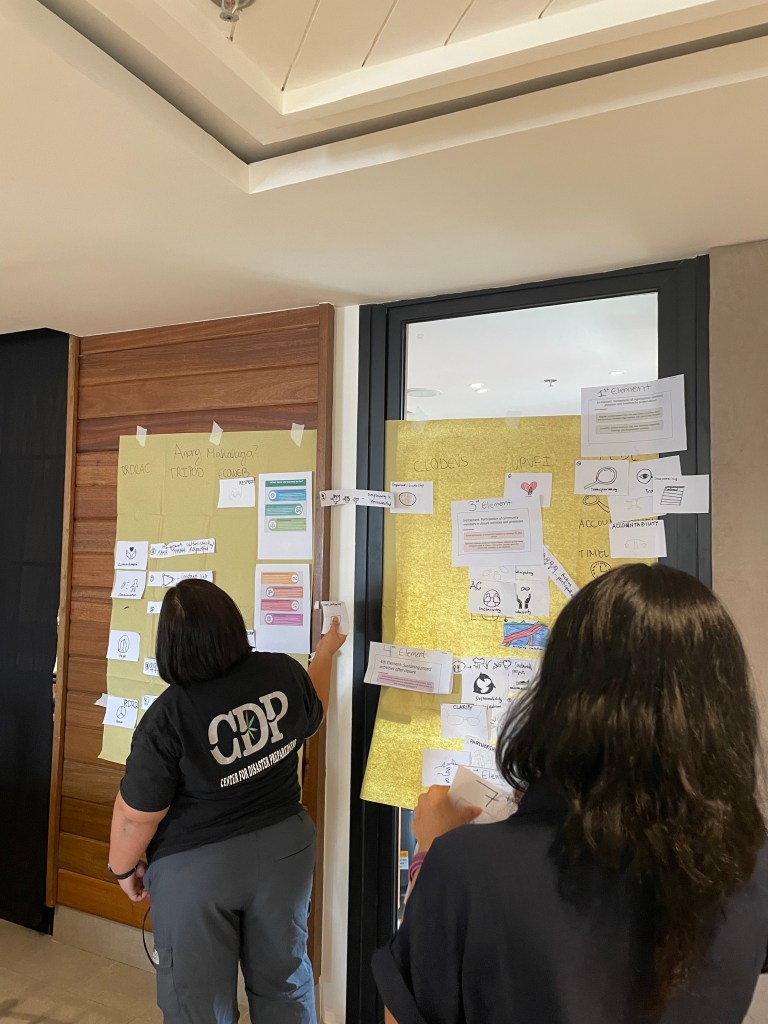
To develop these training resources, the Advisory Board and members from CDP and McGill university met in Manila to discuss preliminary findings of the study.
The 3-day event consisted of a presentation of findings followed by activities to foster dialogue and feedback to refine preliminary results. The meetings included activities to explore in more depth what it would look like to close projects in ways that aligned with the concerns identified by study participants. Advisory board members were invited to reflect upon previous project closures in their communities and aspects they viewed as positive and negative experiences for people living in these settings. They also participated in an activity around planning for a humanitarian project closure and how it could better incorporate considerations of what communities might need and value during this process.
The event facilitated collaboration and feedback mechanisms for the ECP2 project. It allowed opportunities to think about ways to move forward, including plans to develop a training manual.

Community visit
To further consolidate the research findings, the CDP and a member from the McGill team visited one of the communities that participated in the study. They were accompanied by a member of the advisory board who is one of the directors of a local organization, the Cooperation for Local Development Solutions (CLODEVS). The event was facilitated and organized by CLODEVS, CDP, McGill and the local women’s group.
The aim of the visit was to report back on preliminary findings to community members as a way of inviting input from participants. The activities consisted of a skit organized by the women’s group to recall the data collection and interview experience, a game to match common closure processes with values and considerations that are important for the community, and a role play activity on what a good humanitarian project closure would look like from their perspective. The community members participating during the activities were able to ask questions about the research project, the findings, and offer suggestions for knowledge translation activities.
The community members expressed their desire for a booklet containing a summary of findings that will provide them with useful resources when humanitarian organizations conduct projects in their communities.


3. Ethics of Closing Projects (ECP1) (2018-19)
In this project we partnered with the non-governmental organization Médecins du Monde-Canada. The study aimed to explore what values and approaches can support ethical project closures by non-governmental organizations when they decide to close a humanitarian project. We used an integrated study design that combined qualitative interviews and a literature review, with ethical analysis. Combining these approaches, we developed a ‘guidance note’ that highlights ethical capacities and principles, in addition to questions that can support reflection around project closure. The development process included further interviews and a feedback workshop.
Our aim through this project was to spark further discussion and debate around this important topic, with study outputs providing insights regarding the process of making and implementing decisions to close humanitarian projects.
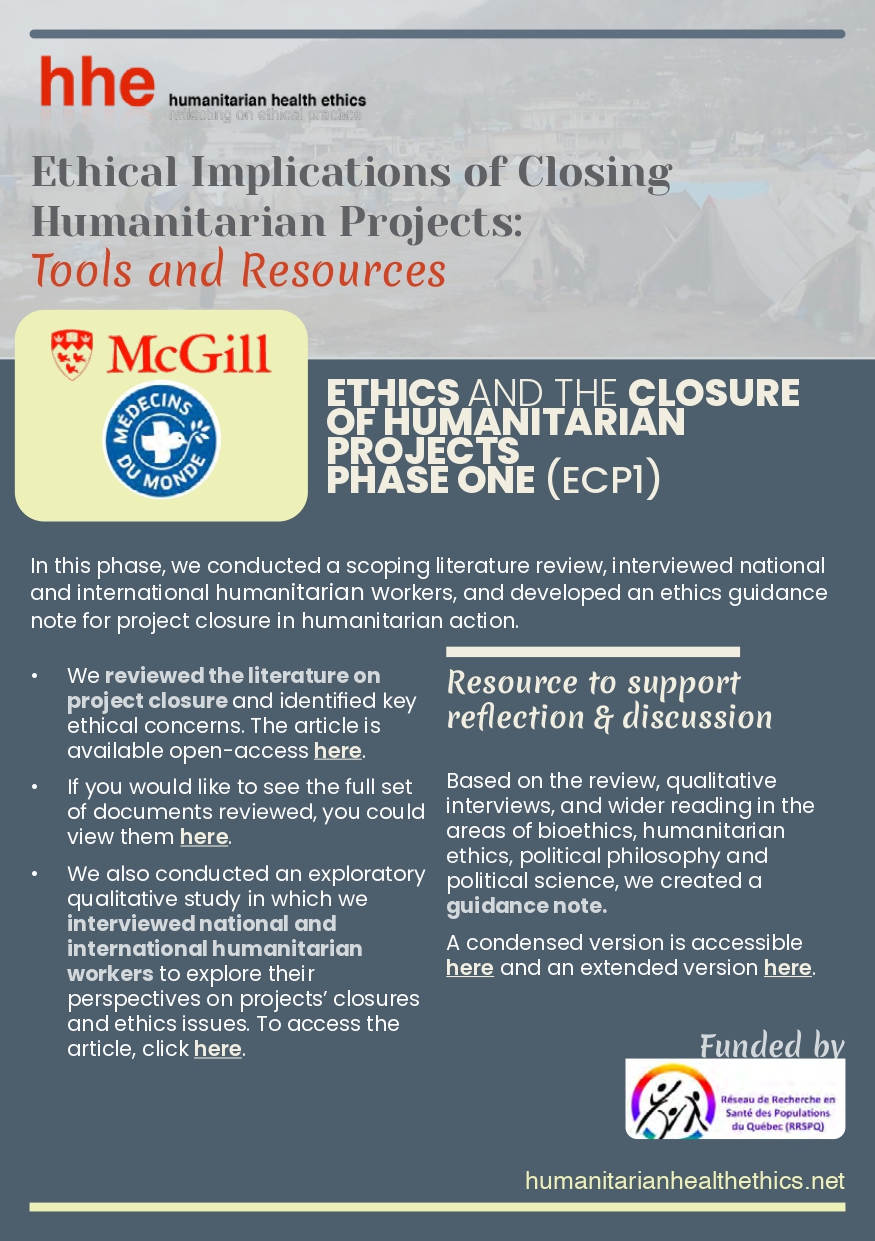
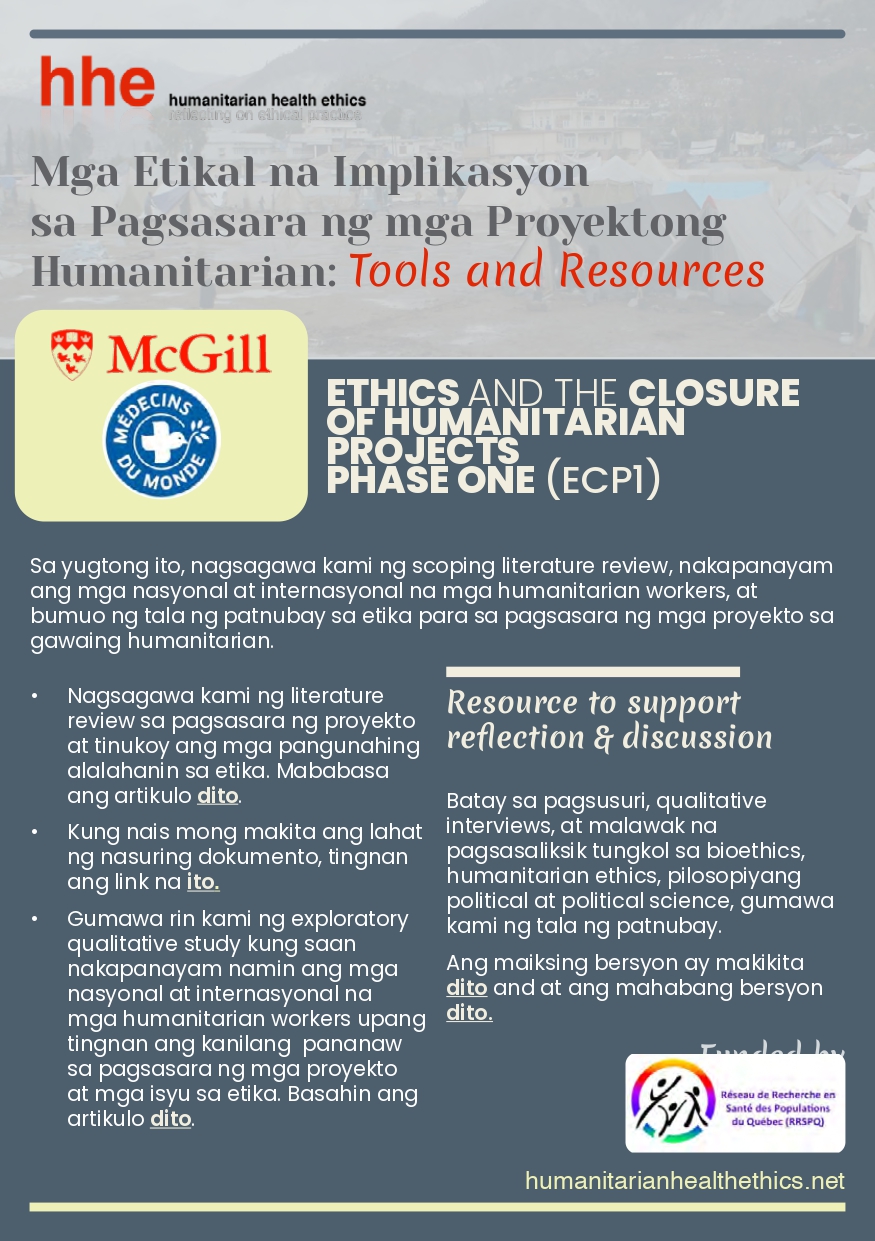
Our project brings together literature, fieldwork, and community insight to explore the ethics of closing humanitarian projects. Below are key components of our work, all available open-access.
📚 Literature Review: Ethics in Project Closure
We conducted a comprehensive literature review of both academic and gray sources to understand how ethical concerns are reflected in guidance documents related to humanitarian project closure.
- 🔍 Explore the article:
Ethics in the humanitarian imperative: A literature review - 📄 Download the full reference list:
[Ethics of Closing Humanitarian Projects – Full List of Reviewed Documents]
🎙️ Interviews with Humanitarian Workers
We carried out an exploratory qualitative study with national and international humanitarian workers to understand how ethical considerations show up across the entire project timeline—from early design to post-closure.
Participants emphasized the importance of:
- Respectfully engaging partners and stakeholders
- Transparent communication
- Caring for communities and staff during closure
- Responsiveness and planning for sustainability
- Minimizing harm and preserving project legacy
- 📘 Read the full article:
Ethical considerations in the phase-out of humanitarian projects
🛠️ Tools for Reflection & Discussion
To support deeper engagement with the ethical dimensions of project closure, we developed a set of reflection tools, refined through follow-up interviews and a feedback workshop.
Available formats:
- 🧾 Extended version – for those wanting comprehensive context and discussion
- ✂️ Condensed version – a shorter guide with key takeaways
- 📄 One-pager – featuring core questions to spark dialogue
 HUMANITARIAN HEALTH ETHICS